
Tight Ship · Operations · Open
In six weeks, one part of your business runs without you in it.
You map where your week actually goes, write one job down properly, hand it over, and prove it runs while you’re away for Christmas.
Seats close November 29 · 49 days leftFull refund up to the second Monday
For owners whose business is already busy.
Your tenth client went through roughly the same twenty steps your first one did, and you’re the only person who knows what all twenty are.
Most of those steps aren’t really the work. They’re the things that have to happen for the work to happen. Somebody waiting on you to approve something. You remembering to tell whoever’s doing it that the client changed their mind on Tuesday. Checking a file before it goes out, because one time it went out wrong. None of that sits on a project plan anywhere and all of it runs through your head.
Which is why hiring didn’t fix it. You handed someone the task and kept every small judgment around the task, because those live in your head and you’ve never had a reason to write them down.
This is about what happens after somebody pays you. The stretch between the money landing and the client holding whatever they bought, including every part of it they never see. Finding clients is February. What you charge is May.
At a glance
What you leave with
One job out of your hands and running without you, plus the method to take out the next one.
- A map of how work actually moves through your business.
- One job written well enough that somebody ran it without asking you anything.
- A check that tells you it’s being done right without you looking at it.
- A weekly rhythm.
- How to do all of that again on your own, which is worth more than the first job you take out.
None of it is a template you fill in later. You build it on the calls, using your own business, and something of yours runs without you before the last session.
What you build, week by week
Every Monday from November 30. The dates are the week each call happens.
- 1Nov 30 to Dec 3
Find where the week goes.
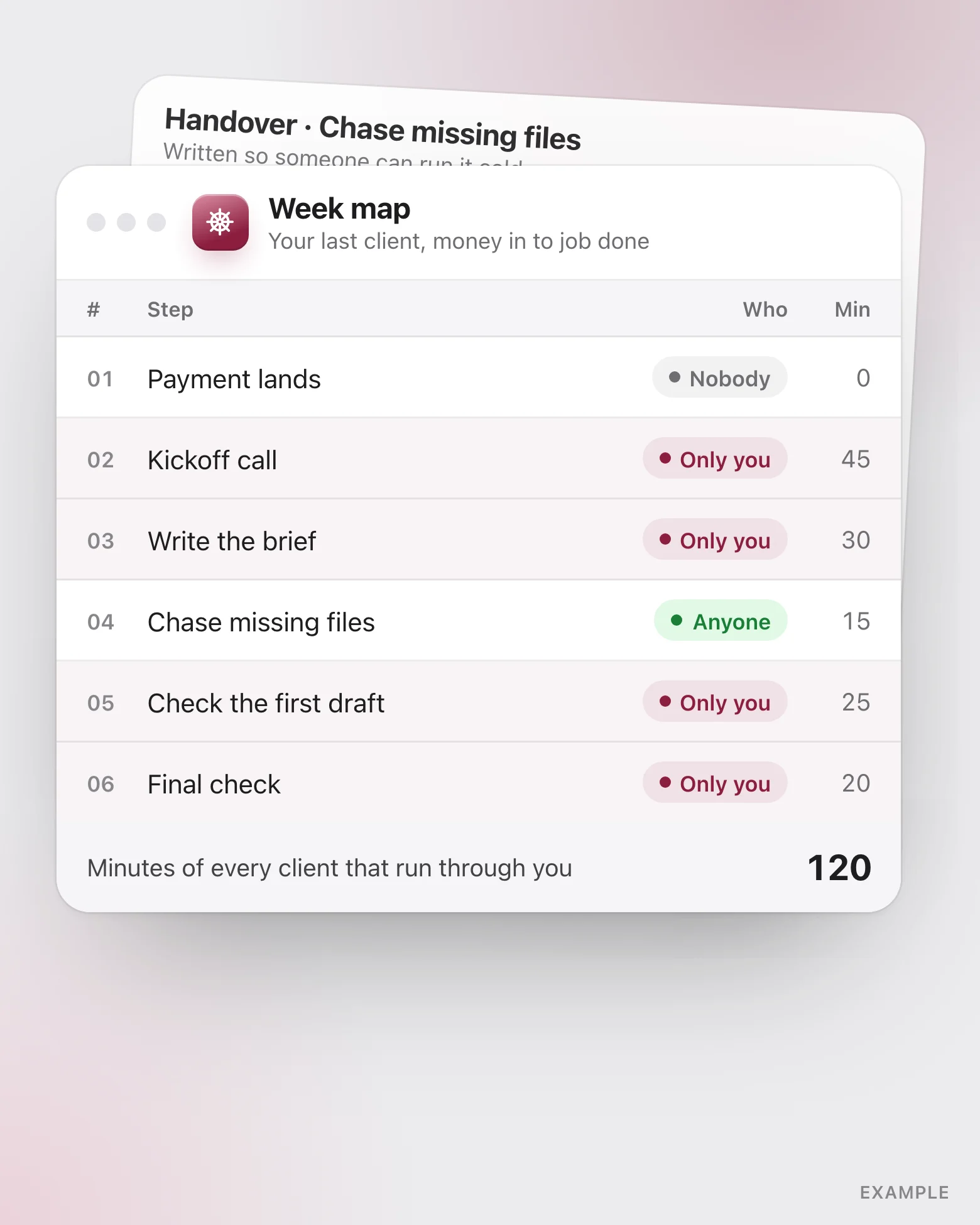
You map what happens from the money landing to the client getting their thing, then everything sitting underneath those steps that nobody sees. The waiting, the chasing, the checking, the deciding. Then you mark every line: only you can do it, anyone could, or nobody needs to. You leave that first Monday with a number for how many minutes of every single client run through you personally.
- 2Dec 7 to 10
Write the first job down.
You pick the line eating the most of you that isn’t genuinely yours. Work leaves your hands three ways, by getting deleted, by a tool doing it, or by a person doing it, and you’ll use all three. Then you write it so somebody could run it cold without coming back to you.
- 3Dec 14 to 17
Hand it over.
Nothing gets written this week. The job gets run without you explaining it to anybody. If you’ve got someone, they run it. If you don’t, you run it straight off the document without improvising, or you pay a contractor for one job.
- Dec 21 to Jan 3
No calls.
Christmas and New Year. The job you handed over runs while you’re away. The seventeen days
- 4Jan 4 to 7
Take out a second one.
Same method, on your own this time, with me watching rather than leading. This is the week you find out the first one wasn’t a fluke, and it’s the week most people stop needing me.
- 5Jan 11 to 14
Build the checks.
What tells you each of those jobs is being done right without you watching it. Then what you do when a check comes back wrong, which is the part everybody skips.
- 6Jan 18 to 21
The weekly rhythm.
What gets looked at, by who, on what day. Then the method written down, so job three and job four happen in February without anybody here.
The seventeen days in the middle
There are no calls over Christmas and New Year. Week three ends on December 17 and week four starts on January 4, which gives you seventeen days where the job you handed over runs while you’re not watching it, over the holidays, with you away from your desk.
That’s the real test. Three days proves nothing. Seventeen days with you gone proves whether the thing you wrote down actually works.
You come back on January 4 with what broke, what didn’t, and what you had to step in and fix. That’s the first twenty minutes of week four, and it’s usually the most useful conversation in the whole six weeks.
Nothing is due over the break and there’s no deadline to miss.

She used to feel like she was all over the place. Now she travels without wondering what is happening at home.
 GoodlifeServices
How it runs

Monday, ninety minutes
The whole room. I teach for twenty minutes and you build for seventy, while I’m there, so you’re not taking it away to finish later.
Wednesday or Thursday, sixty minutes
You’re in a pod of ten and you stay with those ten the whole way through. Your pod gets its own hour, and we go through what you built as a group. Ten people in an hour is real time rather than a turn.
Pod hours, each on its city’s time
You pick your pod hour when you pay, so you don’t end up in a slot that doesn’t work. Work goes in by Tuesday night, and if you send nothing you don’t get reviewed that week.
Pick your pod hour · $600The seats
Fifty standard seats across five pod hours. Five Front Row seats. Hours open as they fill.
Tight ShipFifty seats
Standard
$600 or two payments of $300
Everything above.
- Six Monday calls, ninety minutes each
- Your pod of ten, sixty minutes a week
- The material, the recordings, and your page
You pick your pod hour when you pay.
Tight ShipFive seats
Front Row
$1,600 or two payments of $800
Everything in Standard, plus two things.
- Every week I read what you sent in myself and write back to you, on top of your pod.
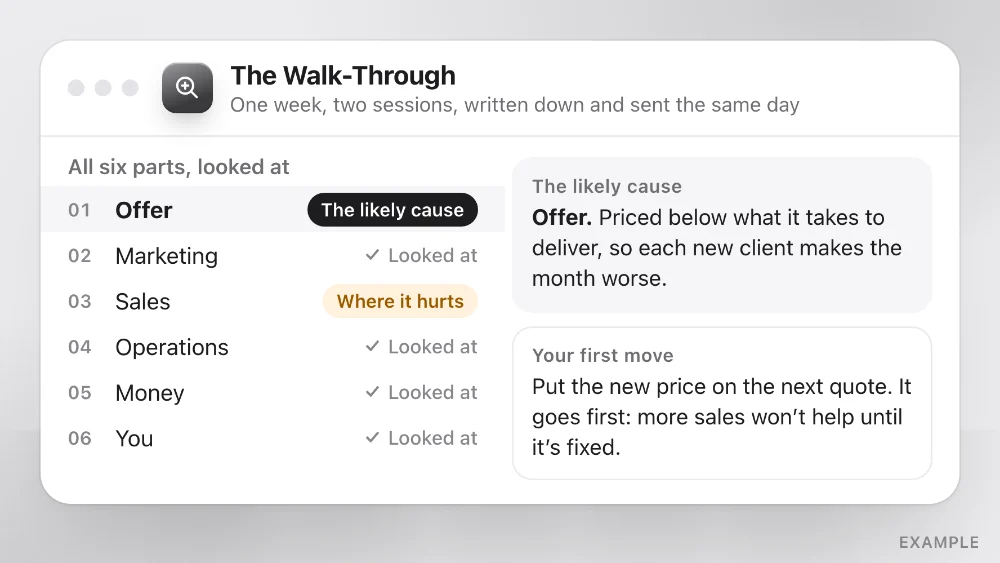
- A Walk-Through after the last session, where I go through your whole business and find what’s actually holding it up.
The Walk-Through happens after rather than before, so there’s a real system on the table when I’m looking at it. A Walk-Through is credited toward the Full Picture if you ever go that way.
Hold me a Front Row seatFront Row Walk-Throughs run the last week of January, so you start the year knowing exactly what to fix.
Either seat can be paid in two goes, half now and half two weeks later. Available until November 29 · 49 days left.
Full refund up to the second Monday. If you get to the second Monday and it isn’t what you wanted, tell me and I’ll refund you in full. You don’t have to give me a reason.
Before you pick your hour
How much time does it take each week?
Two calls. Monday is ninety minutes with the whole room, and your pod is sixty minutes with the same ten people. You build on the calls, so there’s nothing to take away and finish later. Work goes in by Tuesday night.
What if I miss a call?
Every call is recorded, and the recordings sit on your page with the material, so you can catch up the same week.
Can I pay in two parts?
Yes. Either seat can be paid half now and half two weeks later, until November 29.
What if it isn’t for me?
If you get to the second Monday and it isn’t what you wanted, tell me and I’ll refund you in full. You don’t have to give me a reason. The second Monday is December 7.
Which pod hour should I pick?
The one that works every week, not just the first one. There are five, each on its own city’s clock: London, New York, Los Angeles, Dubai and Chicago. You keep it for all six weeks.
What happens after I pay?
You land on a welcome page with every call for your calendar, the one thing to do before we start, and the link to your pod’s group. For Tight Ship, that one thing is mapping your last finished client. It takes about forty minutes.
Who this is not for
This is for a business that’s already running and already busy. If you’re not there yet there’s nothing to put in order.
Pick the hour that works every week.
Seats close November 29. Full refund up to the second Monday.